Optimize Your Gaming Setup: 144Hz Performance on a $1500 Budget (2026)
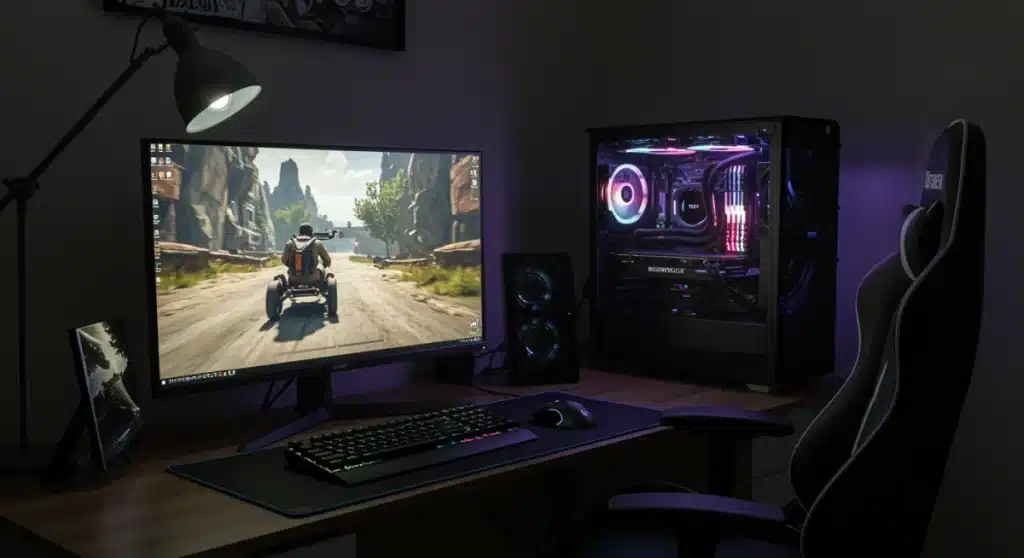
Achieving 144Hz gaming performance on a $1500 budget in 2026 requires strategic component selection, smart optimization, and careful consideration of market trends to build a powerful yet affordable setup in the US.
Are you dreaming of silky-smooth gameplay without breaking the bank? This 2026 guide on optimizing your gaming setup: a 2026 guide to achieving 144Hz performance on a $1500 budget in the US is your ultimate resource. We’ll navigate the evolving tech landscape to help you build a high-refresh-rate system that doesn’t compromise on experience, all within a realistic budget for gamers in the United States.
Understanding 144Hz and its impact on gaming
The jump to a 144Hz refresh rate fundamentally transforms your gaming experience. Unlike standard 60Hz monitors, 144Hz displays refresh 144 times per second, offering significantly smoother visuals and reduced input lag. This translates directly into a competitive advantage in fast-paced games, allowing for quicker reactions and a more immersive feel.
Many gamers, particularly those involved in competitive esports, consider 144Hz a minimum standard for optimal performance. The fluidity it provides reduces motion blur, making it easier to track enemies and react to in-game events. While it might seem like a luxury, achieving this refresh rate is now more accessible than ever, even with a constrained budget.
The visual difference: smooth vs. choppy
The contrast between 60Hz and 144Hz is immediately noticeable. Imagine a high-speed car chase in a game; on a 60Hz monitor, you might perceive a series of distinct frames, whereas on a 144Hz display, the motion appears as a continuous, fluid sequence. This visual fidelity is not just about aesthetics; it’s about how your brain processes visual information during intense gameplay.
- Reduced motion blur: Objects in motion appear clearer and sharper.
- Improved responsiveness: Less delay between your input and on-screen action.
- Enhanced immersion: A more natural and engaging visual experience.
- Competitive edge: Better target acquisition and reaction times in esports.
Ultimately, understanding the benefits of 144Hz is the first step in prioritizing your budget. Every dollar spent on your gaming setup should contribute to achieving this target, balancing performance with affordability to ensure you get the most out of your investment.
Setting your $1500 budget for 2026: where to allocate funds
Allocating a $1500 budget in 2026 for a 144Hz gaming setup requires careful planning and a keen eye on component pricing. The goal isn’t just to buy parts, but to invest in a balanced system where each component complements the others to deliver the desired performance. Prioritizing certain components over others will be key to maximizing your budget’s impact.
The United States market offers a wide range of options, but prices can fluctuate. Keeping an eye on sales, refurbished components, and considering slightly older, still-powerful generations can yield significant savings. Remember, a high frame rate at a low budget means smart compromises, not sacrificing core performance.
Key component priorities for 144Hz
When aiming for 144Hz, your CPU and GPU are the primary drivers. These components will consume the largest portion of your budget. However, overlooking other parts can create bottlenecks, negating the power of your core processors.
- Graphics Card (GPU): This is the single most important component for frame rates. Allocate 40-50% of your budget here.
- Processor (CPU): A strong CPU prevents bottlenecks and ensures smooth performance. Aim for 20-25% of your budget.
- Monitor: A 144Hz monitor is non-negotiable. Factor in 15-20% of your budget.
- RAM and Storage: Sufficient RAM (16GB) and fast storage (SSD) are crucial for overall system responsiveness.
- Power Supply Unit (PSU) and Motherboard: Don’t skimp on these; they provide stability and future upgrade potential.
By understanding these priorities, you can make informed decisions, ensuring your $1500 budget is stretched as far as possible. This strategic allocation will be crucial in building a system that delivers consistent 144Hz performance without overspending on unnecessary features.
Selecting the right CPU and GPU for budget 144Hz gaming
The heart of any 144Hz gaming setup lies in its CPU and GPU. For a $1500 budget in 2026, we’re looking for the sweet spot: components that offer excellent performance per dollar, rather than the absolute bleeding edge. This means exploring current-generation mid-range options and potentially last-generation’s high-end, which often see significant price drops.
AMD and Intel continue to offer compelling processors, while NVIDIA and AMD battle it out in the graphics card market. Researching benchmarks for popular games at 1080p and 1440p resolutions will be vital in making an informed decision, as this directly affects your ability to hit that 144Hz target.
Graphics card: the frame rate engine
Your GPU will largely determine your in-game frame rates. For 144Hz performance on a $1500 budget, focus on GPUs that can consistently deliver high frames in your preferred games at your desired resolution (likely 1080p, possibly 1440p with compromises). Models like the NVIDIA GeForce RTX 4060 Ti or AMD Radeon RX 7700 XT, or their 2026 equivalents, are good starting points.
Consider the VRAM capacity; 8GB is generally sufficient for 1080p gaming in 2026, but 12GB offers more future-proofing. Look for cards that offer good driver support and a strong community, as this can enhance your long-term experience. Often, buying a slightly older generation card on sale can provide exceptional value.
Processor: preventing bottlenecks
While the GPU does the heavy lifting for graphics, a weak CPU can bottleneck even the most powerful graphics card. For a $1500 budget, an Intel Core i5 (current generation) or an AMD Ryzen 5 (current generation) typically provides excellent value. These processors offer enough cores and threads to handle modern games and background tasks without issue.
Benchmark data for your chosen games with various CPU/GPU combinations will be your best friend here. Ensure your chosen CPU is compatible with your motherboard socket and that the motherboard supports the necessary features for your other components. Don’t overspend on an i7 or Ryzen 7 if the budget means sacrificing GPU power; a balanced approach is key.
Choosing the perfect 144Hz monitor on a budget
A 144Hz monitor is not just a display; it’s your window into the smooth gaming world you’re building. While it might be tempting to focus solely on the PC components, a subpar monitor will undermine all your efforts to achieve high frame rates. For a $1500 budget, we need to balance refresh rate, resolution, panel type, and response time without overspending.
The market in 2026 for budget-friendly 144Hz monitors is robust, with various manufacturers offering compelling options. Prioritizing features that directly impact gaming performance will help you avoid unnecessary costs.
Essential monitor specifications
When shopping for your monitor, several specifications are non-negotiable for a great 144Hz experience. The refresh rate is obvious, but don’t overlook response time, which dictates how quickly pixels can change color. A low response time (1ms-5ms GTG) is ideal for competitive gaming.
- Refresh Rate: Must be 144Hz or higher.
- Resolution: 1080p (Full HD) is the most budget-friendly for 144Hz. 1440p (QHD) is possible but will require a stronger GPU or lower in-game settings.
- Panel Type: IPS panels offer great color and viewing angles but can be pricier. TN panels are often faster and cheaper but have poorer color reproduction. VA panels offer good contrast.
- Adaptive Sync: Look for FreeSync or G-Sync compatibility to prevent screen tearing. FreeSync is generally more common on budget monitors.
By focusing on these core specifications, you can find a monitor that delivers excellent 144Hz performance without breaking your $1500 budget. Remember to check user reviews and professional benchmarks to ensure the monitor lives up to its claims.
Optimizing RAM, storage, and other essential components
While the CPU, GPU, and monitor are the stars of a 144Hz gaming setup, other components play crucial supporting roles. Skimping on RAM, storage, or even your power supply can lead to performance issues, system instability, or slow load times, ultimately detracting from your gaming experience. These components need to be selected carefully to ensure a balanced and efficient system within your $1500 budget.
The goal is not to buy the cheapest parts, but the most cost-effective ones that meet the performance requirements. In 2026, certain standards have become widely adopted for gaming PCs, and adhering to them will provide the best value.
RAM: speed and capacity
For modern gaming, 16GB of RAM is the sweet spot. Anything less can lead to stuttering, especially if you run background applications. DDR4 is still a viable budget option in 2026, though DDR5 prices are becoming more competitive. Aim for a speed of at least 3200MHz for DDR4 or 5200MHz for DDR5 to ensure your CPU has fast access to data.
- Capacity: 16GB (2 x 8GB sticks for dual-channel performance).
- Speed: Minimum 3200MHz (DDR4) or 5200MHz (DDR5).
- Latency: Lower CL (CAS Latency) numbers are better, but often come at a premium.
Storage: SSD is non-negotiable
Gone are the days of mechanical hard drives for your primary game storage. An NVMe SSD is essential for fast boot times, quick game loading, and overall system responsiveness. A 1TB NVMe SSD is a good starting point, providing ample space for your operating system and several large games.
You can supplement this with a larger, cheaper SATA SSD for additional game storage or even a traditional HDD for less demanding files if your budget is extremely tight. However, prioritize the NVMe for your main games.
Power supply and motherboard: the unsung heroes
A reliable power supply unit (PSU) is crucial for system stability and longevity. Don’t cheap out here. A 650W-750W 80 Plus Bronze or Gold rated PSU should be sufficient for most budget 144Hz builds. The motherboard ties everything together. Choose one compatible with your CPU, offering enough RAM slots, M.2 NVMe slots, and sufficient USB ports for your needs. Look for reputable brands and read reviews to ensure reliability.
Smart buying strategies and build tips for 2026
Building a high-performance gaming PC on a $1500 budget in 2026 requires more than just picking parts; it demands smart buying strategies and efficient build practices. The US market offers various avenues for acquiring components, and knowing how to navigate them can save you hundreds of dollars without compromising on your 144Hz goal. Patience and research are your greatest allies.
From understanding market trends to leveraging sales, every decision you make before and during the build process contributes to the final cost and performance. Don’t be afraid to explore non-traditional purchasing methods to stretch your budget further.
Leveraging sales and discounts
Major sales events like Black Friday, Cyber Monday, Amazon Prime Day, and seasonal clearances are prime opportunities to snag components at significantly reduced prices. Keep an eye on deal aggregator websites and set price alerts for your desired parts. Retailers often offer bundles that can provide better value than buying individual components.
Consider buying slightly older, but still powerful, generations of components. As new generations launch, the previous ones often see substantial price drops, offering excellent performance per dollar. Refurbished components from reputable sellers, often with warranties, can also be a goldmine for budget builders.
DIY vs. pre-built and component sourcing
For a $1500 budget, building your PC yourself (DIY) almost always offers better value than a pre-built system. You have full control over component selection, avoiding any unnecessary or inferior parts often included in pre-builts. Online tutorials and communities make PC building more accessible than ever.
Source your components from reputable online retailers like Amazon, Newegg, Best Buy, and Micro Center. Compare prices across multiple vendors. Don’t forget to factor in shipping costs if applicable. For those in proximity to a Micro Center, their in-store CPU/motherboard bundles can offer exceptional savings.
Software optimization and ongoing maintenance
Even with carefully selected hardware, achieving and maintaining 144Hz performance on a budget requires ongoing software optimization and diligent maintenance. Your operating system, drivers, and game settings all play a crucial role in how efficiently your system runs. Neglecting these aspects can lead to frame drops and a less-than-ideal gaming experience, even with powerful components.
Regular updates, smart settings adjustments, and efficient system management are key to squeezing every last frame out of your $1500 setup. This is where expertise meets experience, ensuring your investment continues to deliver peak performance.
Driver updates and operating system settings
Always keep your graphics card drivers, chipset drivers, and operating system (Windows) updated. Manufacturers frequently release performance optimizations and bug fixes that can significantly impact frame rates. Additionally, tweak Windows power settings to ‘High Performance’ and disable unnecessary background applications that consume CPU and RAM resources.
Ensure your monitor is actually set to 144Hz in Windows display settings. It’s a common oversight that can lead to frustration. Check your GPU control panel (NVIDIA Control Panel or AMD Radeon Software) for game-specific optimizations and global settings that can boost performance.
In-game settings and cooling solutions
Learning to adjust in-game graphic settings is paramount for a budget build. Prioritize settings that have a high impact on visuals (like texture quality) over those that heavily affect performance (like shadows, anti-aliasing, or ray tracing). Experiment with different combinations to find the sweet spot between visual fidelity and frame rate. Often, medium settings can still look great while offering significant performance gains.
Good cooling is essential for consistent performance. Ensure your PC case has adequate airflow and consider adding extra case fans if temperatures run high. Overheating components can throttle performance, reducing your frame rates. While a budget build might not allow for custom liquid cooling, a decent air cooler for your CPU and good case ventilation will go a long way.
| Key Component | Budget Allocation (Approx.) |
|---|---|
| Graphics Card (GPU) | 40-50% of budget ($600-$750) |
| Processor (CPU) | 20-25% of budget ($300-$375) |
| 144Hz Monitor | 15-20% of budget ($225-$300) |
| RAM & Storage | 10-15% of budget ($150-$225) |
Frequently asked questions about 144Hz budget gaming
▼
Yes, absolutely. While it requires strategic component selection and smart shopping, a $1500 budget in 2026 is realistic for achieving 144Hz performance, especially at 1080p resolution. Focusing on value-oriented mid-range GPUs and CPUs, along with a budget 144Hz monitor, makes it achievable for US gamers.
▼
For 144Hz gaming, the GPU typically has a greater impact on frame rates than the CPU. You should allocate a larger portion of your budget to the graphics card (40-50%). However, a balanced approach is crucial to avoid CPU bottlenecks, so a mid-range CPU is still essential to ensure smooth performance.
▼
Achieving consistent 144Hz at 1440p on a $1500 budget is challenging but possible with compromises. You’d need to invest more heavily in your GPU and likely play games on lower settings. For a more consistent 144Hz experience, 1080p is generally recommended within this budget to ensure smoother gameplay.
▼
Yes, buying refurbished components can be a great way to save money, provided you purchase from reputable sellers like Amazon Renewed or manufacturer-certified programs. Always ensure refurbished items come with a warranty. Components like CPUs, RAM, and even GPUs can be good candidates for refurbishment, offering great value.
▼
Regularly updating your graphics card drivers is arguably the most crucial software optimization. GPU manufacturers frequently release performance-enhancing updates. Additionally, ensuring your in-game settings are optimized (balancing visual quality with frame rate) and that your Windows power plan is set to ‘High Performance’ significantly impacts 144Hz consistency.
Conclusion
Building a gaming setup capable of 144Hz performance on a $1500 budget in the US by 2026 is an entirely achievable goal with the right approach. By strategically allocating funds towards your GPU and CPU, selecting a cost-effective 144Hz monitor, and not overlooking essential supporting components like fast RAM and NVMe storage, you can craft a powerful yet affordable machine. Remember that smart buying strategies, such as leveraging sales and considering DIY assembly, along with consistent software optimization and maintenance, are vital to maximizing your investment and enjoying the fluid, immersive gaming experience that 144Hz provides. The journey to high-refresh-rate gaming on a budget is one of informed choices and careful planning, resulting in countless hours of smooth, competitive gameplay.